Knife Skills: The Basic Cuts Every Home Cook Should Know
Most of the time spent in a home kitchen is not spent cooking, it is spent chopping, slicing, and dicing. Investing an afternoon in basic knife skills pays off every single time you cook afterward, because consistent cuts mean food cooks evenly and prep goes faster.
The first habit to build is the claw grip. Curl your non-knife hand's fingertips under, using your knuckles rather than fingertips as the guide surface for the blade. This keeps fingers safely tucked away and gives you a stable reference point so the knife can move at a steady, controlled speed rather than stopping and starting.
The rock chop is the workhorse cut for herbs, garlic, and onions. Keep the tip of the knife in light contact with the cutting board and rock the blade up and down through the food, moving your guide hand backward as you go. This technique is faster and safer than lifting the knife entirely off the board between every cut.
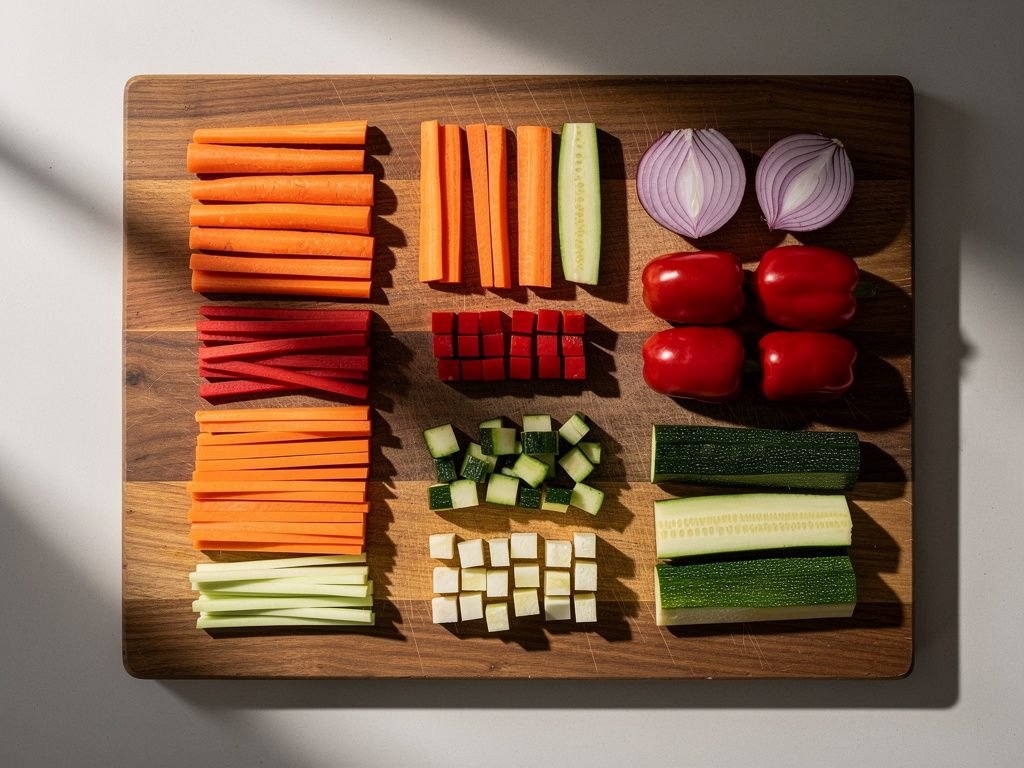
A julienne, or matchstick cut, starts by squaring off a vegetable like a carrot or bell pepper into a rectangular block, then slicing it into thin planks, stacking the planks, and cutting those into thin strips. Squaring the vegetable first is the key step most beginners skip, and it is what makes the final strips uniform instead of wildly different sizes.
A brunoise is simply a julienne cut again into small cubes, commonly used for aromatics like shallots or for a fine vegetable garnish. It takes practice to get consistently small, but even an imperfect brunoise cooks more evenly than randomly hacked pieces.
Dicing an onion efficiently uses a similar squaring logic. Halve the onion through the root, peel it, lay each half flat side down, make horizontal cuts nearly to the root without cutting through, then vertical cuts, and finally cut across to produce even dice while the root end holds everything together until the last few cuts.
For round vegetables like tomatoes or onions that want to roll, cut a small stabilizing slice off one side first so the vegetable sits flat on the board. This single adjustment prevents a huge share of knife slips in home kitchens.
Finally, keep your knife sharp. A dull blade requires more downward force, which increases the odds it will slip off the food and onto a finger. A few strokes on a honing steel before each use, and a proper sharpening every few months, will do more for your safety and speed than almost any other single change to your routine.
More from the Journal

Choosing the Right Cooking Oil for Every Dish